HARD BULLET – When Absolute Freedom Becomes the Real Challenge
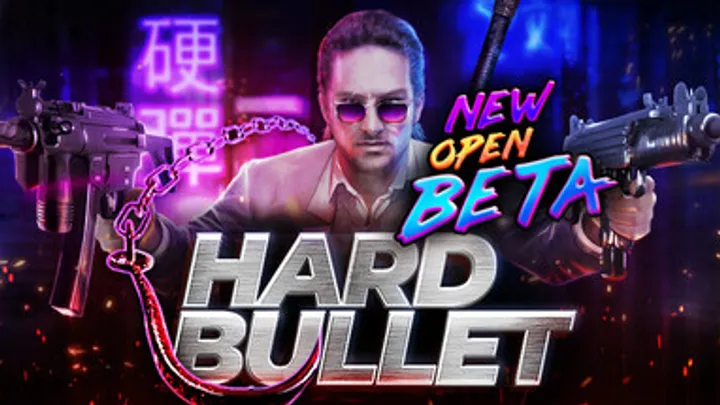
HARD BULLET presents itself as an unfiltered sandbox shooter, overflowing with slow motion, destructible environments, and extreme physical violence. On the surface, it appears to be a power fantasy that removes traditional constraints and invites players to revel in chaos. However, beneath this apparent freedom lies a far more subtle design experiment. By offering almost total mechanical liberty and minimal systemic punishment, HARD BULLET transforms the player’s experience into a psychological confrontation with excess. This article explores how the game reframes challenge not as mechanical difficulty, but as the ability to impose restraint, intention, and meaning within an environment that actively resists structure.
1. The Immediate Granting of Total Power
From the opening moments, HARD BULLET removes traditional progression barriers.
Players are equipped with lethal weapons, slow-motion abilities, and physics interactions that would normally be endgame rewards.
This immediate empowerment eliminates the anticipation loop found in most action games, shifting the focus away from earning power toward deciding how to use it.
2. Physics as the Core Combat Language
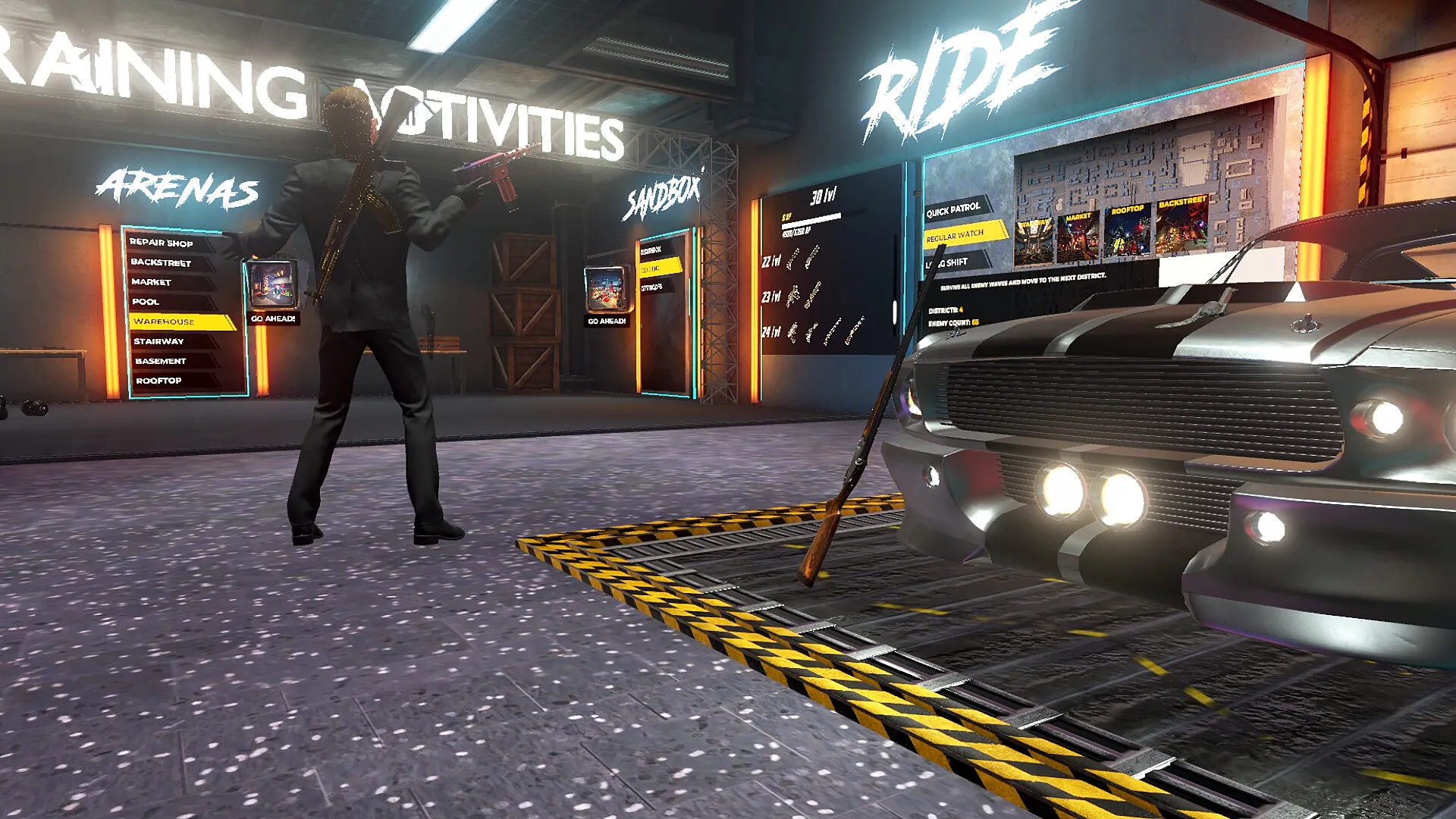
Combat in HARD BULLET is driven by physics rather than stats.
Enemy bodies react dynamically to force, momentum, and impact angles, creating unpredictable outcomes.
Kinetic authorship
Every encounter becomes a unique physical event authored by the player’s inputs rather than predefined animations.
3. Violence Without Mechanical Consequence
The game places few systemic limits on brutality.
There are no morality meters, no reputation systems, and no narrative reprimands.
Ethical vacuum
Without punishment, violence loses contextual meaning and becomes a test of player intent.
4. Slow Motion as a Tool for Excess
Bullet time is not a scarcity resource.
Players can remain in slow motion for extended periods, turning combat into prolonged spectacles.
Temporal distortion
Time manipulation encourages indulgence rather than precision.
5. Environmental Interactivity Removes Tactical Necessity
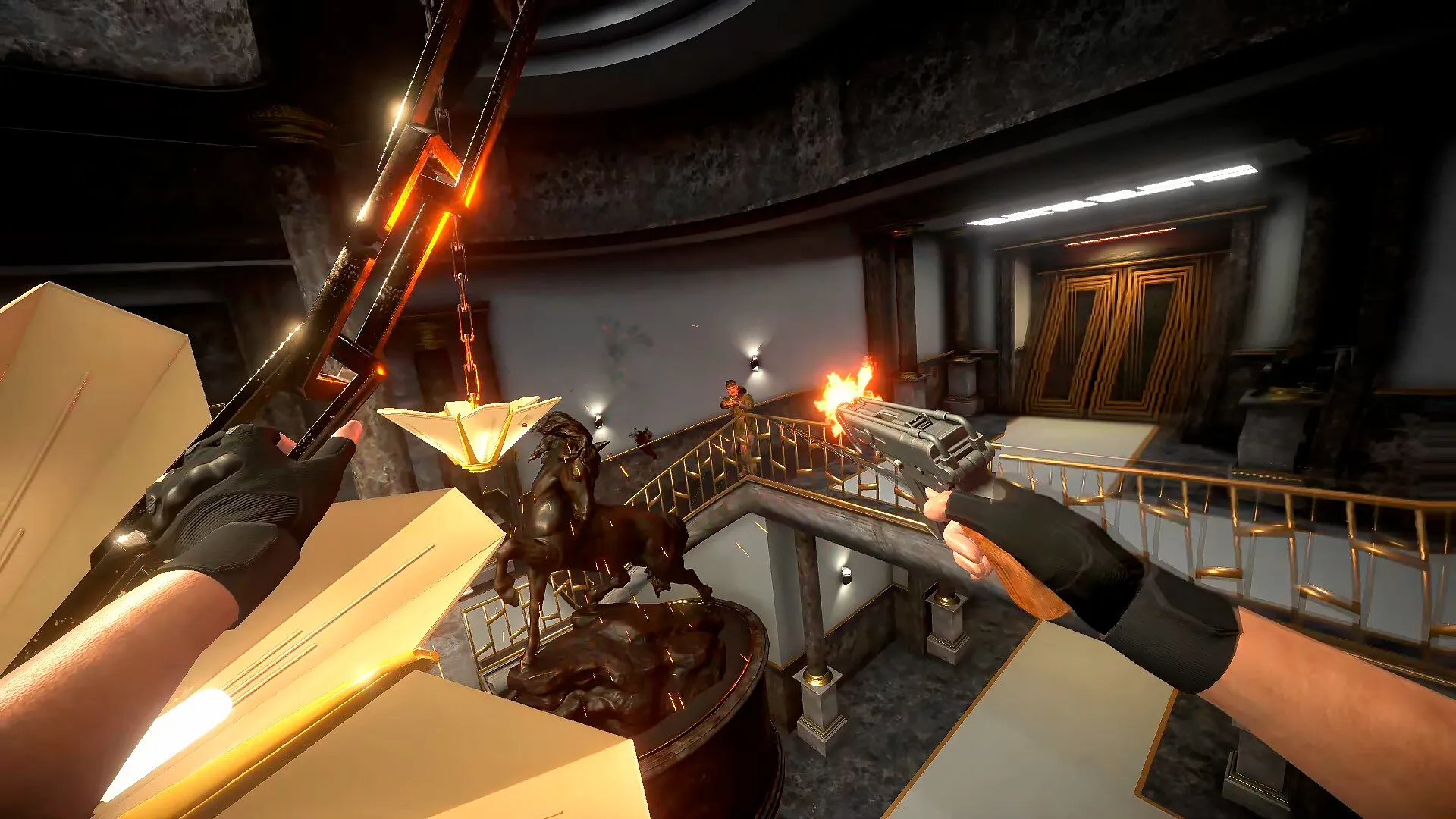
Almost every object can be weaponized.
Furniture, debris, and enemy bodies become tools of destruction.
Improvised lethality
The abundance of options removes the need for optimal play.
6. The Absence of Structured Objectives
Levels offer minimal guidance.
Players are rarely directed toward specific goals beyond elimination.
Self-directed play
Meaning emerges only if the player chooses to create it.
7. When Mastery Becomes Boredom
Technical mastery arrives quickly.
Once players understand physics manipulation and enemy behavior, challenge plateaus.
Excess saturation
Without escalation, power loses novelty.
8. Player Self-Regulation as Emergent Difficulty
Experienced players impose personal constraints.
They experiment with weapon limitations, movement restrictions, or stylistic rules.
Voluntary challenge
Difficulty becomes a self-authored experience.
9. Spectacle Versus Purpose
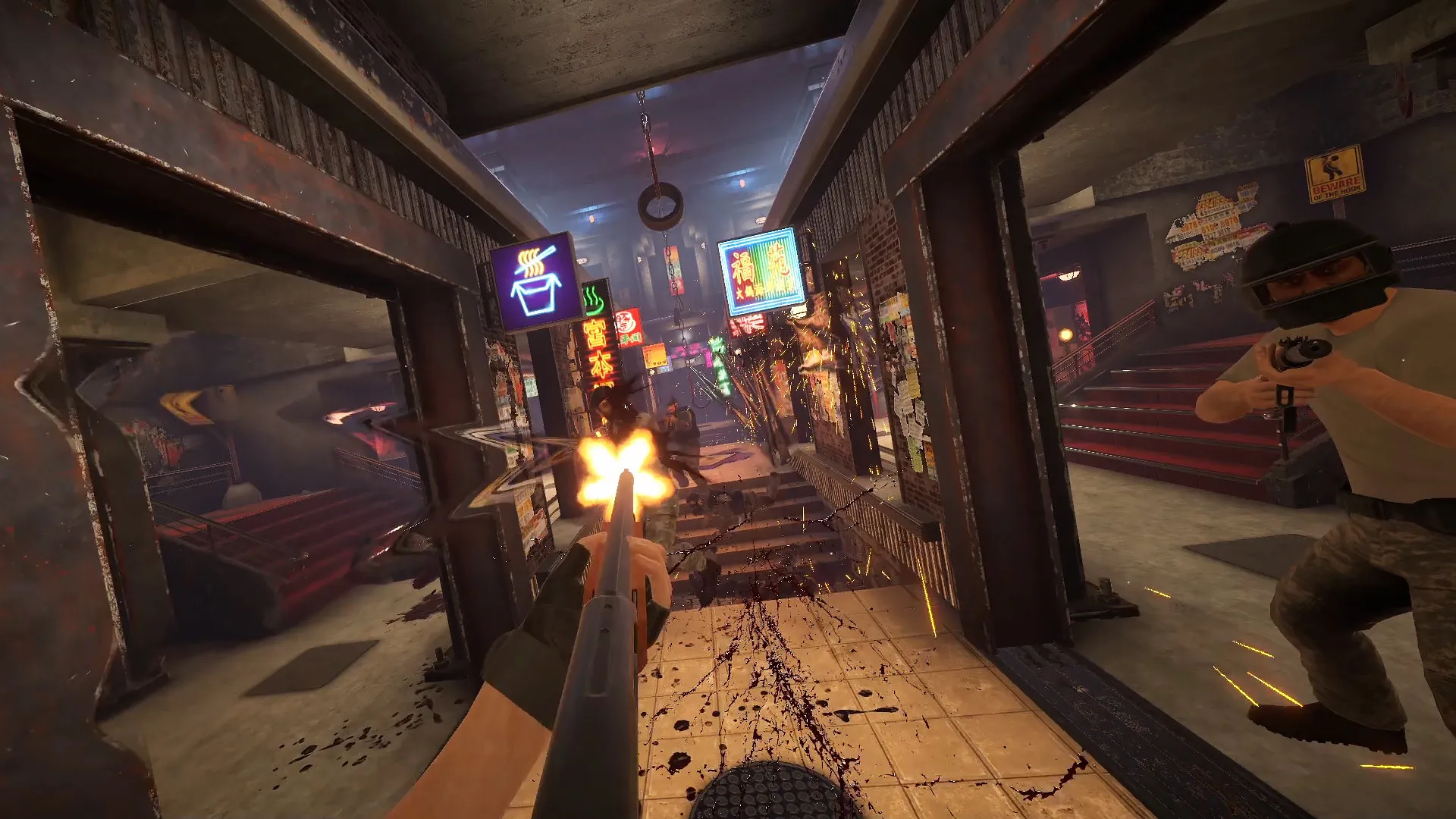
The game excels at producing visually striking moments.
However, spectacle alone cannot sustain engagement indefinitely.
Meaning deficit
Without purpose, spectacle becomes hollow repetition.
10. Why HARD BULLET Tests the Player, Not the System
The game never pushes back mechanically.
Instead, it reflects the player’s choices back at them.
HARD BULLET’s true challenge lies in resisting excess and finding intentional play within limitless freedom.
Conclusion
HARD BULLET is not a test of reflexes, accuracy, or tactical planning. It is a test of restraint. By stripping away progression gates, moral consequences, and structured objectives, the game exposes the player’s relationship with power and violence. Some players will exhaust its possibilities quickly, overwhelmed by abundance. Others will discover depth by imposing structure where none exists. In this way, HARD BULLET functions less as a traditional shooter and more as an experiment in player psychology, asking a simple but uncomfortable question: what do you do when nothing stops you?